
Would your estate agency still work if you doubled the instructions?
Most estate agency owners would love to double the number of instructions coming into their business. But there is a second question that is probably more important. What would happen if you actually did and would you lose the profit by needing more people?
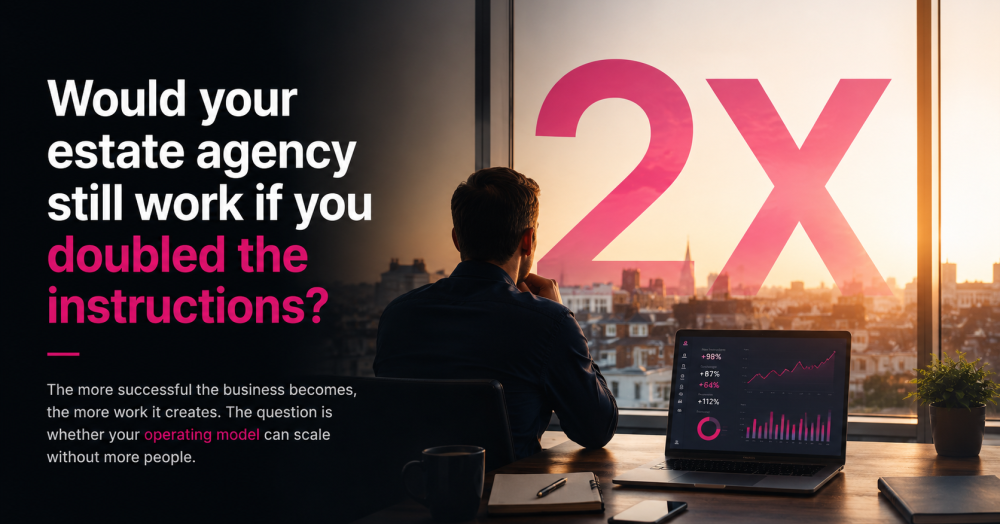
Would your existing team comfortably handle twice the workload, or would growth immediately mean more negotiators, more administrators, more managers, more chasing, more meetings and more people trying to keep on top of everything?
That is the problem hiding inside the traditional estate agency growth model. The more successful the business becomes, the more work it creates. And the more work it creates, the more people it usually needs to employ to deal with it. Revenue goes up, but headcount, management and complexity often go up with it.
You have not necessarily created a more scalable business. You have created a bigger version of the same business. For years, most estate agency technology has tried to solve this by helping people work faster.
The CRM stores the information. Automation sends some of the messages. Portals generate enquiries. Dashboards help managers see what is going on. AI can now write property descriptions, emails, social posts and other content in seconds.
But in most agencies the human being is still sitting in the middle of the operating model. They still have to decide who to call, what to do next, which vendor needs attention, which buyer might move, which old valuation might come back to market, which sale needs intervention and which opportunity is hiding somewhere inside the database. Then, once they have worked that out, they still have to do the work.
That is why simply adding AI to a traditional CRM does not necessarily transform an estate agency. It can just make the old model move faster.
There is a much bigger opportunity.
Imagine arriving at work and not having to search through a CRM trying to work out where your attention should go. Instead, the system has already looked at the objectives of the business, what is happening across the database, how customers are behaving accross your website, social and email and which situations are most likely to create an outcome. It can identify who matters today and why.
Before someone picks up the phone, they can already understand the context, what has happened previously and what conversation is worth having and when the call finishes, the conversation itself can become useful intelligence. It can be understood, summarised, linked back to the right people and properties, and turned into actions without somebody spending the next ten minutes typing notes and creating tasks.
In sales progression, your team should not need to spend the whole day chasing every transaction for updates. Much of the predictable work can happen in the background, with people stepping in when judgement, reassurance, negotiation or human expertise can actually change the outcome.
That is a very different operating model and that is why I think one of the biggest mistakes businesses can make with AI is to ask the wrong question as most people are asking, “How can AI help our people do more?”
Whereas a much more valuable question is, “Which work should our people be doing at all?”
Human beings are incredibly valuable when they are building trust, persuading, negotiating, advising, empathising and solving unusual problems but they are incredibly expensive when they are being used as workflow engines to remember this, chase that, update this and check whether somebody replied, then look through a list and decide who to call. Send another confirmation. Find out what happened. Then tell somebody else.
For decades we have not had much choice but now we do and as the operating model changes, the economics of the business can change with it.
One Iceberg customer increased revenue per employee from £66,000 to £133,000 without hiring more people, while profit increased 52% year on year. Another increased revenue per employee by 87% in 12 months. Another grew turnover from £2.7 million to £4.6 million while also increasing revenue per employee.
Those numbers point towards something much bigger than saving a few hours of administration. They suggest that the economics of an estate agency can change when technology is used to redesign how the business works, rather than simply helping people perform the old model more efficiently.
So go back to the original question.
What would happen if you doubled your instructions?
If your immediate thought is that you would need more people, then that may be the biggest opportunity inside your business.
Perhaps the next stage of growth should not come from asking your existing team to work harder.
Perhaps it should not even come from giving them a better CRM.
Perhaps it comes from redesigning the business so technology takes ownership of more of the predictable work, while your people concentrate on the moments where being human actually matters.
That is what we have been building at Iceberg, not another collection of AI tools, and not a CRM with AI bolted onto it. An AI Operating System designed around a different question:
What outcome is the business trying to create, and where can human attention create the greatest value?
The easiest way to understand that difference is not through a list of features.
It is to see what a normal working day looks like when the business operates this way.
If you are thinking seriously about growth, profit, headcount and how AI should actually change the way your estate agency works, that is exactly what our discovery session is designed to explore.
We will look at how your agency operates today, where human time is being consumed, where opportunities are being missed, and what a more outcome-led way of working could look like.
This is not a generic software demo.
It is a conversation about the business you could build.
Book a call
Unlock the transformative power of our AI Operating System for Estate Agents. Designed to replace an agents prospecting tools, CRM, marketing tools, compliance tools and even their website in order to future proof their business and increase profit.
First Name*
Last Name*
Email*
Mobile Number*
Company*
Which best describes your estate agency?
Are you the final decision maker for technology and strategic investments in your company?
Any other information
Please confirm that it is okay for us to contact you about this information as well as our products and services. By confirming, you also agree to the use of cookies to enhance your experience. (You will always have the right to unsubscribe or manage your cookie preferences at any point in the future.)*
Latest news
On-Demand Webinar: Vertical Drop The AI decisions that will define your business
Every estate agent is being offered AI tools. The bigger question is whether the decisions you're making today are building an advantage that will still matter when everybody has them. Watch this webinar to see where we believe this is heading.
Read more

What Is Revenue Per Employee (RPE) in Estate Agency? | A Complete Guide
Revenue per employee (RPE) shows how efficiently your estate agency turns staff time into revenue. Learn the formula, UK benchmarks, and how AI can improve it.
Read more

AI Operating System vs Traditional CRM | What's Actually Different?
A traditional CRM records what happened. An AI operating system for estate agencies acts on it. Here's what actually separates the two, and why it matters for growth.
Read more